 Counter-Strike 2
CS2 boosting is one of those topics where half the Reddit threads are rage posts and the other half are people quietly asking for service links in DMs. If you want the real breakdown of everything to know about CS2 boosting, you’re in the right spot. I’ve spent the last two months testing services, reading Valve’s enforcement actions, and tracking what actually gets people banned.
Last updated: April 14, 2026 (Animgraph 2 Beta update, April 2, 2026)
What is CS2 boosting and how does it actually work?
CS2 boosting is a paid service where a high-rated player raises your Premier rating by either playing on your account or queuing alongside you. Services cover Premier, Competitive map ranks, Wingman, and Faceit Elo. Prices range from around $15 for small rating jumps to over $500 for full climbs from Grey to Red or Yellow tier.
The basic loop is simple. You pick a service, choose your current rating and target rating, pay, and a booster gets to work. Some services let you watch live through screen sharing. Others just send you a notification when it’s done.
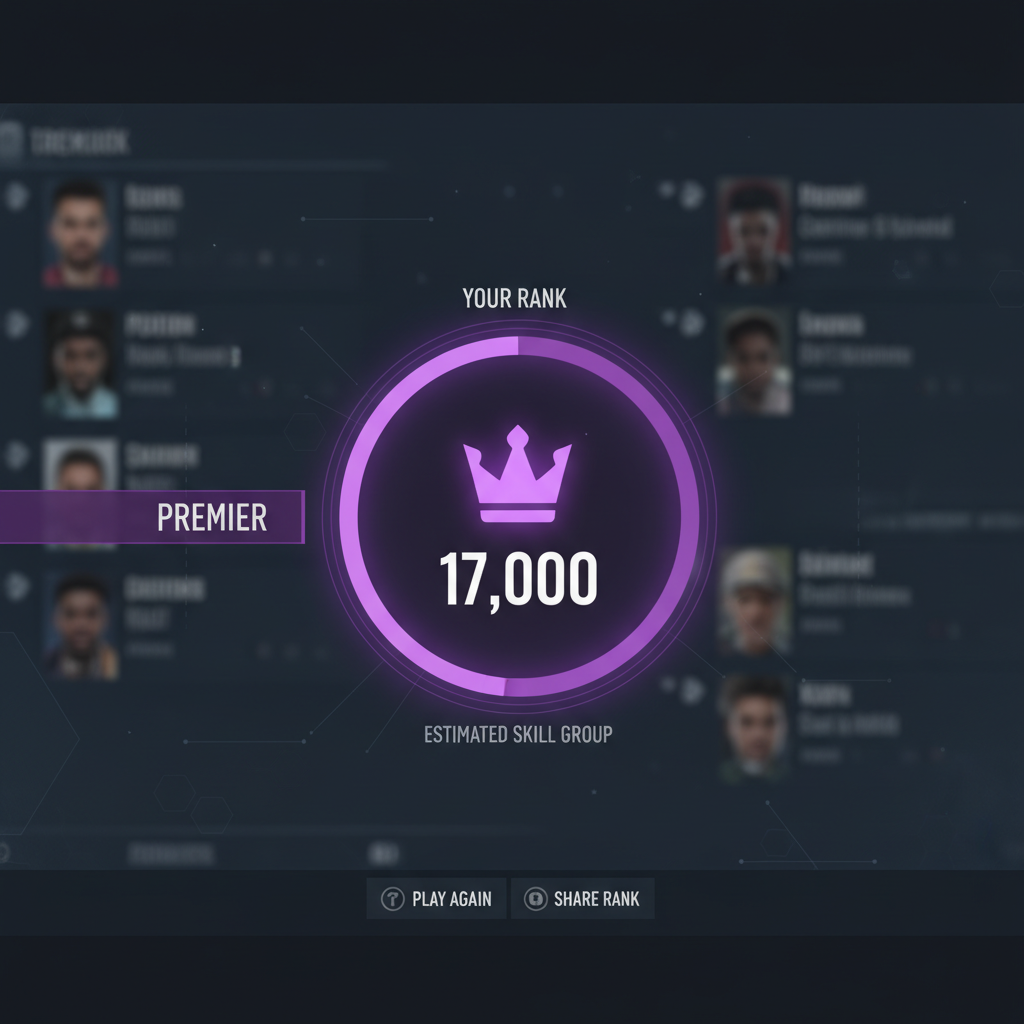
Two main formats exist: account sharing and self-play. Account sharing means you give your login to a pro player who grinds on your behalf. Self-play means you party up with the booster and play the matches yourself while they carry. I tried a self-play CS2 Premier boost last month, going from 11,200 to 15,800 over 9 games. The booster dropped 28 kills on Inferno in one of those. Felt like smurfing from the passenger seat.
How does the CS2 Premier rating system work in 2026?
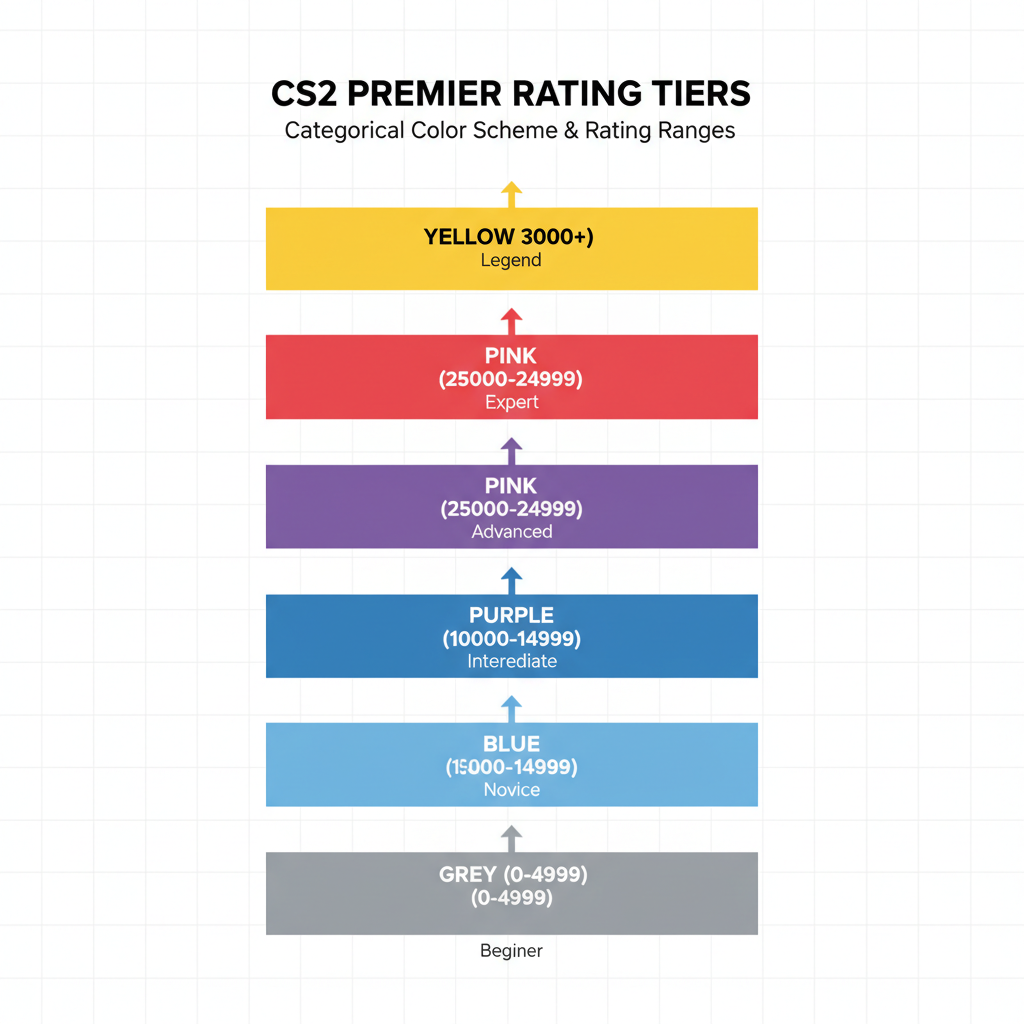
If you’re paying for a boost, you should understand what you’re buying. CS2’s Premier mode uses a numeric Counter-Strike Rating that spans seven color-coded tiers:
| Tier Color | Rating Range | Player Percentile |
|---|---|---|
| Grey | 0 – 4,999 | Bottom ~17% |
| Light Blue | 5,000 – 9,999 | Average |
| Blue | 10,000 – 14,999 | Above average |
| Purple | 15,000 – 19,999 | Top ~15% |
| Pink | 20,000 – 24,999 | Top ~3% |
| Red | 25,000 – 29,999 | Top ~1% |
| Yellow | 30,000+ | Top 0.1% |
According to TradeIt’s ranking breakdown, the average Premier rating sits around 8,900, which puts most players squarely in Light Blue. You gain between 100 and 500 rating per win depending on your recent record. Winning streaks push that number up. Losing streaks crush it.
Check out our full CS2 Premier ranking guide if you want the deep dive on how rating gains and losses are calculated per match.
Before each Premier game, both teams ban maps from the active pool. The team that bans second picks the starting side. Matches run MR12 format (first to 13 rounds, max 24 rounds, overtime at 12-12). Your rating moves based on wins and losses. Individual performance matters for placement matches but not for regular games after that.
Is CS2 boosting safe or will you get banned?
This is the question everyone asks. Here’s the honest answer: it depends on the type.
Valve’s official policy says that “falsely increasing your Skill Group or Counter-Strike Rating” can lead to a game ban, according to CS2Pulse’s analysis. Those bans are permanent with almost no appeal path.
But here’s the thing. Valve’s enforcement in 2026 has mostly targeted bot farms and XP farming operations. In January 2026, PCGamesN reported a ban wave that hit accounts exploiting Deathmatch sessions for service medal progression. Valve developer Ido Magal confirmed that around 970,000 farming bot accounts were removed. That’s bots, not boosted accounts.
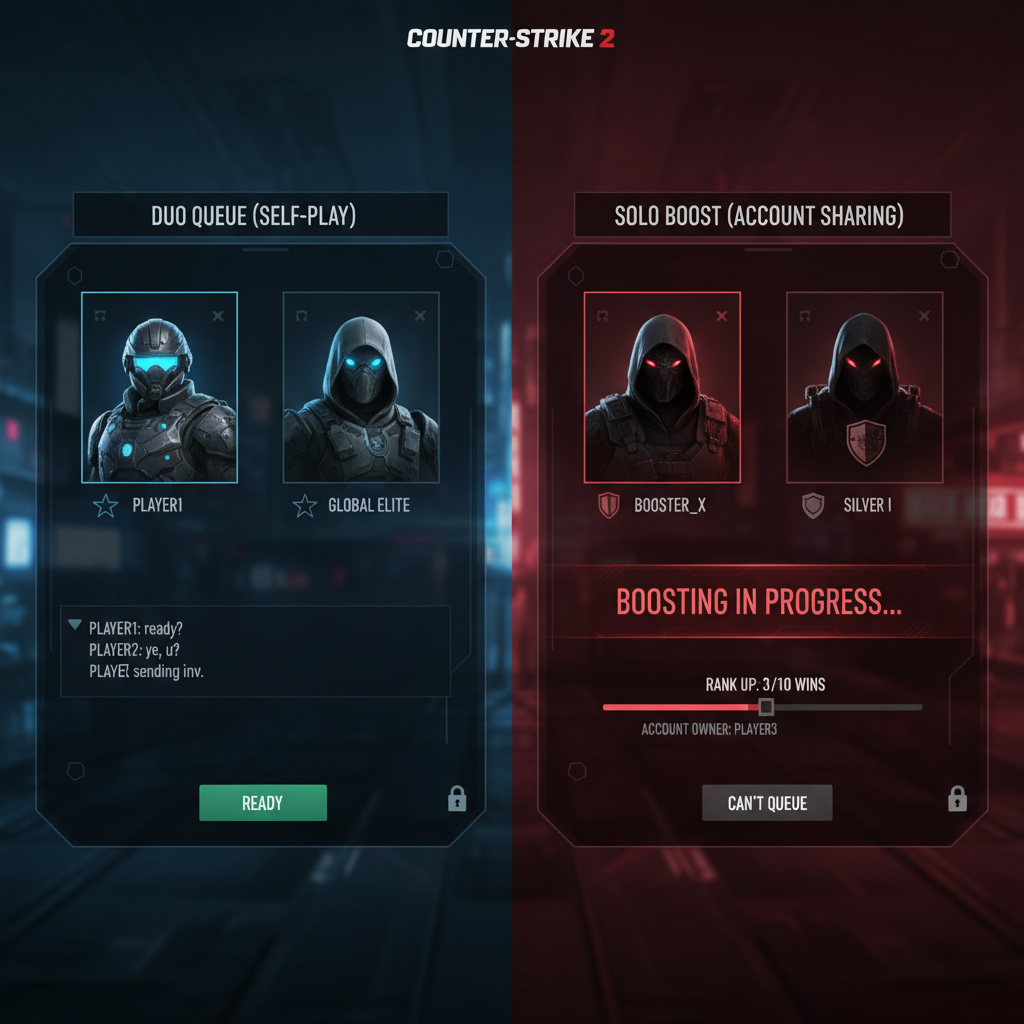
Self-play boosting (where you queue with a skilled player) is the lowest-risk option. You’re on your own account, playing your own matches. Valve can’t easily distinguish between you playing with a friend who’s better than you and you paying someone to carry. The grey area is real.
Account sharing is riskier. If you’re in Germany and your booster logs in from Romania at 3 AM, that’s a flag. Good services use VPNs to mask this, but it’s not foolproof. I personally won’t account-share anymore after a scare in February where my Trust Factor tanked for two weeks (it recovered, but those two weeks of terrible matchmaking were rough).
My take: Valve will crack down harder on account-sharing boosts within the next year. The Trust Factor system is getting smarter, and the January ban wave shows they’re investing in detection. Self-play is probably fine for now, but don’t bet your 10-year-old Steam library on it.
What types of CS2 boosting services exist?
Not all boosts are the same. Here’s what’s actually out there:
Premier Rating Boost is the most popular. You pick your start and end rating, and the booster grinds wins until you hit the target. This is what most people mean when they say “cs2 boost.”
Placement Match Boost targets your initial 10 placement games. Individual performance counts during placements, so a strong booster can place your account in Purple or even Pink right out of the gate.
Competitive Map Rank Boost is map-specific. CS2’s competitive mode gives you separate ranks per map. You could be Global on Mirage and Silver on Ancient. Boosters can target specific maps you care about.
Wingman Boost covers the 2v2 mode. Faster matches, smaller teams, generally cheaper.
Faceit/ESEA Boost handles third-party platforms where the serious competitive players live. Faceit Level 10 boosts are a whole separate market with higher prices.
If you’re looking at options, Playplex’s CS2 boosting page covers Premier, placement, and competitive boosts with real-time order tracking.
How much does CS2 boosting cost and is it worth it?
Real numbers. A 5,000-point Premier boost (say, 10k to 15k) runs between $30 and $80 depending on the service. A full climb from Grey to Pink might cost $200 to $400. Yellow tier? You’re looking at $500 or more. Self-play costs roughly 30-50% more than account sharing because the booster can’t guarantee results as easily.
Is it worth the money? Honestly, that depends on why you’re stuck. If you’re hardstuck at 12k because you solo queue and get throwers every other game, a boost to 16k puts you in lobbies where people actually use mics and buy as a team. The quality-of-life jump is real. I noticed it immediately when my account hit Purple (the callouts alone were worth it, people actually knew smokes).
But if you’re stuck because your aim is genuinely 8k-level, you’ll drop back down within a few weeks. Boosting fixes your rank. It doesn’t fix your crosshair placement.
What changed in CS2’s April 2026 update that affects boosting?
The Animgraph 2 Beta update on April 2, 2026 overhauled all third-person animations in CS2. Player models look more grounded now, counter-strafing is easier to read visually, and some players on lower-end machines reported FPS gains around 8%.
Why does this matter for boosting? The animation changes affect peeking and angle-holding. Ramp height calculations got reworked entirely, which means some old grenade lineups are broken. Boosters who relied on specific smoke spots for T-side executes had to relearn them. The March 19 update also changed reload mechanics to be more punishing (reloads don’t auto-resume after interruption), adding another skill gap that separates booster-tier players from average ones.
FAQ
Can you get banned for boosting in CS2?
Valve says artificially inflating your CS Rating can lead to a permanent game ban. In practice, most bans in 2026 have targeted bot farms and XP exploits rather than individual boosted accounts. Self-play carries less risk than account sharing.
How much does CS2 boosting cost?
Small jumps of a few thousand rating cost $15 to $80. Full climbs across multiple tiers can run $200 to $500 or more. Self-play services cost about 30-50% more than account-sharing options because of the added difficulty.
How long does a CS2 Premier boost take?
Expect 3 to 6 days for a moderate climb like 5,000 to 15,000 rating. Larger gaps of 10,000 to 25,000 can take 7 to 14 days. Win streaks speed things up since you gain more rating per win when your record is hot.
What’s the difference between self-play and account-sharing boosts?
Self-play means you party up with a booster and play every match yourself while they carry. Account sharing means you give your login to a booster who plays on your account while you’re away. Self-play costs more but keeps your credentials private.
Does CS2 boosting affect my Trust Factor?
It can. Unusual login patterns from account sharing (different IP, different country, odd hours) may trigger Trust Factor drops. Even with VPN masking, there’s no guarantee. Lower Trust Factor means worse teammates and longer queue times.
That’s everything to know about CS2 boosting heading into mid-2026. The market is bigger than it’s ever been, Valve’s enforcement focuses more on bots than boosted players, and self-play is the safest bet if you go this route. Just don’t expect a rank boost to replace actual practice. If you’re ready to climb, check out Playplex’s CS2 Premier boost for current pricing and delivery times.