 League of Legends
So you opened your TFT profile, saw a rank badge, and wondered if you’re actually decent or just telling yourself you are. I’ve been staring at these distribution numbers for a week. Here’s where you really land.
Last updated: April 14, 2026 , TFT patch 16.8, with Set 17 Space Gods launching tomorrow on patch 17.1.
What is the TFT rank distribution in 2026?
Based on March 2026 Set 16 data from Esports Tales, the TFT rank distribution puts 29% of players in Gold, 23% in Platinum, and 22% in Silver. Only 5.8% sit at Diamond or above, and Challenger is locked to roughly 0.021% of the ladder worldwide.
That’s the headline. The fatter detail is that TFT’s ladder looks nothing like League of Legends’ Summoner’s Rift curve, where Silver and Bronze swallow the majority. In TFT, Gold is the median and the bulge is higher. Most players climb past Bronze because the game gives you 5 provisional matches after every set reset with no LP loss for bottom-4 placements.
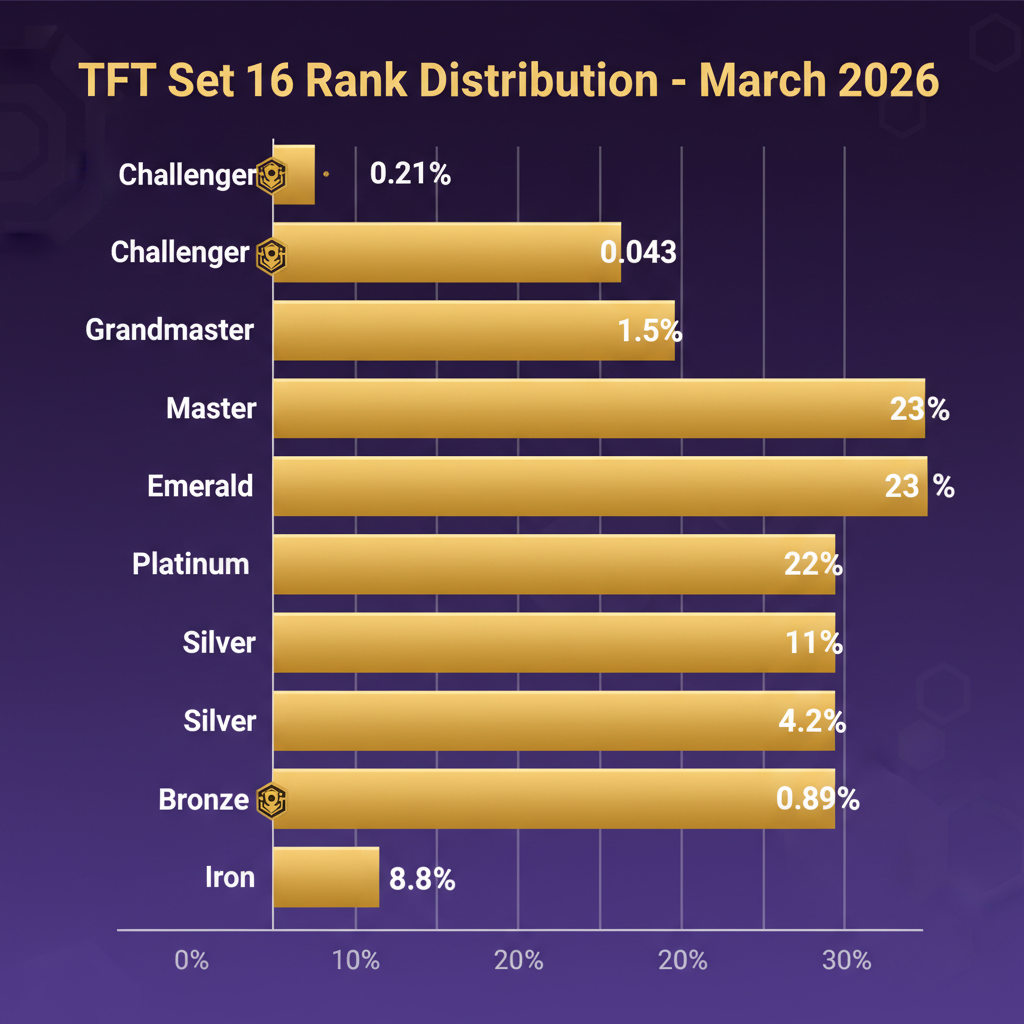
Full TFT rank percentage breakdown for Set 16
Here’s the table I keep pulling up when my duo tries to flex his Plat 4. Numbers pulled from Esports Tales’ March 2026 snapshot of the Set 16 ladder:
| Rank | % of players | Cumulative (you’re above this %) |
|---|---|---|
| Iron | 0.89% | , |
| Bronze | 8.8% | 0.89% |
| Silver | 22% | 9.69% |
| Gold | 29% | 31.69% |
| Platinum | 23% | 60.69% |
| Emerald | 11% | 83.69% |
| Diamond | 4.2% | 94.69% |
| Master | 1.5% | 98.89% |
| Grandmaster | 0.043% | 99.39% |
| Challenger | 0.021% | 99.43% |
A few things jump out. Silver-through-Platinum is 74% of the entire ladder. That’s where the real fight happens. Diamond is still a serious rank , you’ve beaten 94.7% of players just getting there.
I climbed from Gold 1 to Plat 2 across 14 games last patch, and my lobby difficulty barely moved. That tells you how compressed that middle band is.
What rank is top 10% in TFT?
Short answer: high Platinum or Emerald. The math is blunt. Platinum alone covers 23% of players, so Plat 4 is NOT top 10. You need to push through Plat into Emerald before you’re genuinely top-tier.
Top 10% in TFT sits somewhere around Emerald 3 or Emerald 2 based on cumulative distribution. Hit Diamond and you’re top 5.8%. Master is top 1.11%. Honestly, Master in TFT hits harder than it does in League because the ladder’s upper shoulder is thinner.
Compared to League solo queue, where Plat-and-above is roughly 15.8% per the April 2026 LoL distribution, TFT’s top-heavy distribution isn’t radically different, but the Gold/Plat bulge is pronounced. If you want context on how ranked works in LoL for a side-by-side feel, the structures mirror each other but the climb curves don’t.
Why TFT ranks cluster in the middle
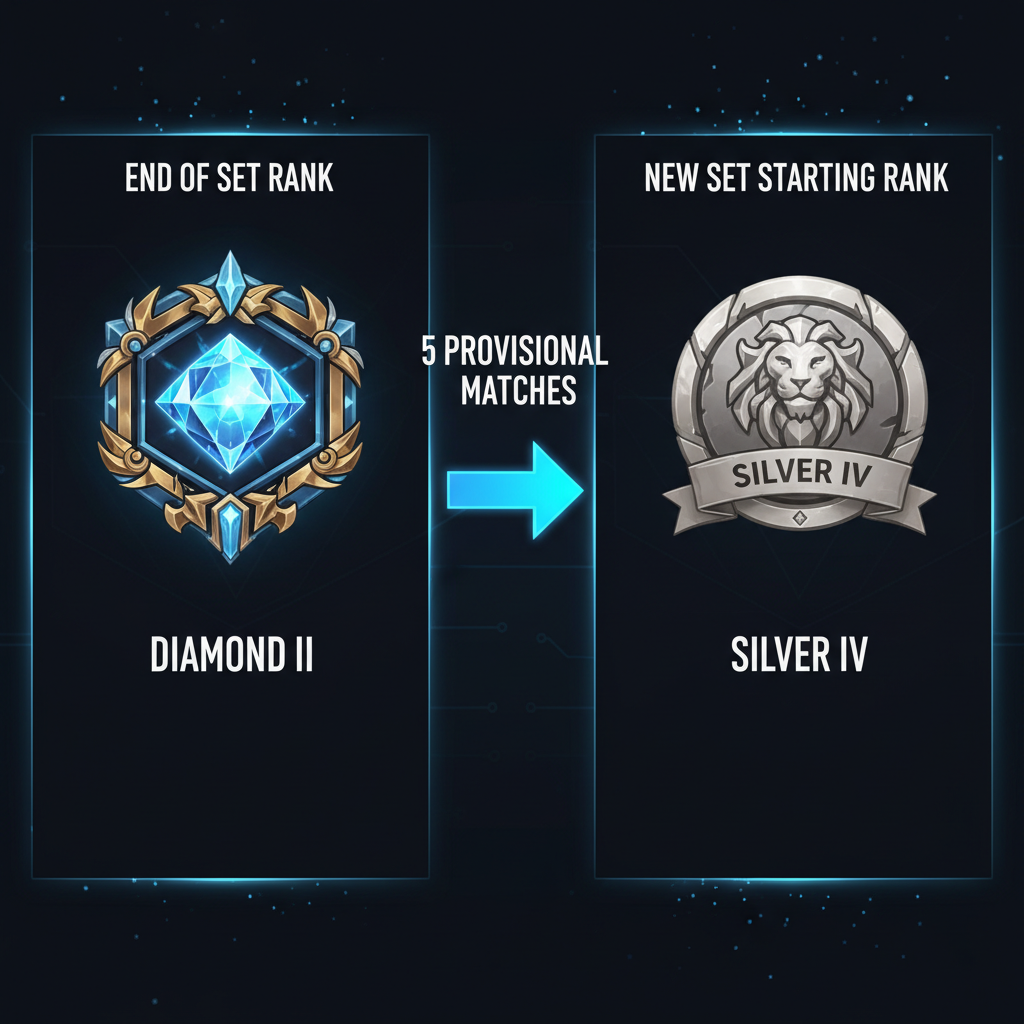
Three reasons. First, soft resets. When Set 17 drops tomorrow, per Esports Tales, “depending on your rank in the previous set, you will start anywhere from Iron II to Silver IV.” That floor lifts everyone off the bottom.
Second, 5 provisional matches where bottom-4 costs no LP. Free LP farming if you win even one. Third, the game rewards placement, not wins only. Top 4 earns LP. That means half the lobby gets rewarded every game. Contrast that with League, where 5 people lose and 5 win. Flat.
Is that a problem? I don’t think so. TFT’s ladder is more honest about skill because variance-per-game is lower. You place 3rd thirty times and you WILL climb. No carry, no flame, no ff at 15.
How Set 17 Space Gods changes the distribution
Set 17 launches April 15 on patch 17.1 per the official Riot overview. That means the Set 16 numbers you just read are about to get shuffled. Hard.
New mechanics hitting the ladder:
– ** of the Gods replaces the traditional carousel. Players pick between two randomly selected Gods each game.
– Roughly 40 new Augments** including 8 Hero Augments that hand champions alternate abilities.
– Returning units: Master Yi, Pyke, Maokai. First-time 5-costs: Fiora, Shen, Vex, Graves, Blitzcrank.
Expect the distribution to temporarily skew lower during the first two weeks of Set 17. Soft resets drop returning Diamond players to roughly Platinum, Master players to Emerald, and so on. The ladder flattens, then stretches back out over 3-4 weeks as competent players re-climb.
My bet? The Gold bulge shrinks slightly this set because Hero Augments amplify skill expression. I could be wrong. Riot has walked back Hero Augment power before, so if they tune them down on 17.2 the distribution snaps right back to what you saw in March.
Where do you actually stack up?
Be honest with yourself. If you’re Silver, you’re better than about 10% of the ladder (everyone in Iron plus a chunk of Bronze). If you’re Gold, you’re at the median. Plat is top 40%. Emerald is top 17%. Diamond is top 6%.
The trap is comparing TFT ranks to League ranks 1-to-1. They don’t map. A TFT Diamond player is doing comp theory, econ math, positioning checks, and scout-before-you-commit reads every round. A LoL Diamond player is doing mechanics. Different skills, similar rarity.
If you burn out on TFT and want to push a different queue, LoL rank boosting is there. Some grinders I know keep a fresh LoL smurf account for testing low-elo TFT lobbies without risking their main’s MMR — same Riot account, same TFT rank slot. Worth knowing if you hate the post-reset grind.
How to actually climb through the middle tiers
I won’t write a full guide here (that’s a separate post), but the short version that carried me last set:
- Play one comp until you can pilot it in your sleep, then pick up a flex pivot that shares 2-3 traits.
- Econ first. Hit 50 gold by stage 3-2 or you’re behind.
- Scout at 4-1 and 4-5. Non-negotiable.
- Top 4 is a win. Stop forcing 1sts in lobbies where you’re clearly 3rd-best.
That last one is the single biggest LP leak I see in Gold and Plat lobbies. Players see a 3rd-place board and hit level 9 roll-down trying to flip it. Nine out of ten times they bottom-4. I’ve done it. You’ve done it. Stop doing it.
FAQ
What rank is the top 10% in TFT?
Platinum and above puts you in roughly the top 16% per Esports Tales’ March 2026 numbers. To crack the top 10% cleanly you need to push into high Plat or Emerald. Emerald through Challenger combined is about 16.8% of the ladder.
Is Gold good in TFT?
Gold is the exact median. 29% of players live there, and hitting Gold means you’ve beaten over 60% of the ladder when you stack Iron, Bronze, and Silver on top of each other. It’s not elite, but it’s genuinely above average.
Why is there no Iron in TFT distributions?
There is, it’s just tiny. Iron holds only 0.89% of the ladder because soft resets between sets drop most returning players into Bronze or Silver instead. Brand-new accounts go through placements that usually land them higher than Iron too.
How does the Set 17 rank reset work?
Per Esports Tales, your Set 17 start rank depends on your Set 16 finish, landing anywhere from Iron II to Silver IV. You get 5 provisional matches where bottom-4 placements cost zero LP, so climbing early is basically free.
What percent of TFT players are Challenger?
Roughly 0.021% per the March 2026 Set 16 distribution. Challenger is capped per region, so it’s not a percentage threshold, it’s a fixed slot count. That’s why it barely moves even when the ladder grows.
Closing thought
Your rank isn’t a character flaw, it’s a data point. Gold means median, Plat means above average, Diamond means you’re playing a genuinely different game. With Set 17 landing tomorrow, everyone’s numbers reshuffle — so if you were hardstuck last set, tomorrow’s your shot.